Best MSP Software in 2026: 9 Tools Compared by Price, Fit, and What They Actually Do
The best MSP software in 2026 depends on which layer of the stack you are filling. NinjaOne is the RMM to beat. HaloPSA is the PSA most 10 to 50 tech shops switch to. Rallied is the AI layer that closes L1 and L2 tickets inside whichever PSA you already run, at $150 a month for about 700 tickets in a typical month. Atera and Syncro cover both PSA and RMM on one per-tech bill.
The nine at a glance
| Tool | Layer | Pricing model | Fits |
|---|---|---|---|
| NinjaOne | RMM | Per device, roughly $1.50 to $3.75 a month | Any MSP that wants the most polished RMM and patching |
| Rallied | AI ticket resolution | $150 a month for 2,000 credits | MSPs on ConnectWise, HaloPSA, or Autotask that want L1 tickets closed without a tech |
| HaloPSA | PSA | Per agent, $35 to $109 a month | 10 to 50 tech shops that want ConnectWise depth without the implementation drag |
| Atera | All-in-one | Per tech, $149 to $219 a month | Growing device counts, AI features bundled in |
| Syncro | All-in-one | Per tech, $179 to $209 a month | 3 to 30 tech shops that want one bill for RMM, PSA, and M365 security |
| SuperOps | All-in-one | Quote only | New MSPs with no legacy stack to migrate |
| Datto RMM | RMM | Quote only | Autotask shops and Kaseya customers |
| N-able N-central | RMM | Quote only | Large, complex estates with an admin who can configure it |
| ConnectWise PSA | PSA | Quote only | 50+ tech MSPs already inside the ConnectWise platform |
How we chose
We kept tools that MSPs actually run their businesses on, with public G2 or Capterra reviews, active r/msp discussion, and pricing we could either find or explain. Each entry covers a distinct job in the stack, so there are no near-duplicates padding the count. The four layers are PSA (business operations), RMM (endpoints), all-in-one (both), and AI ticket resolution (closing the ticket). Most MSPs need something in each, or one tool that covers two.
Rallied is our product. It sits at number two because the one thing every other tool on this list leaves undone is the ticket itself, and that is the job it does. We have kept the entry to what the product does today and what it will not do.
1. NinjaOne
Fits MSPs of any size that want the smoothest RMM on the market.
NinjaOne has held the number one spot on G2 for RMM software for 23 consecutive quarters. It manages Windows, Mac, Linux, cloud, and mobile endpoints from one console and scores 9.3 for ease of use on G2, which is why most shops are fully running within a week of signing.
Patching is where it pulls ahead. Autonomous patching covers the OS and more than 6,000 third-party applications, and Patch Intelligence reads CVE data and community signals to hold unstable updates before they go out. One r/msp member described it as "the only tool that saved us from a bad Windows KB that would have bricked machines." FedRAMP Moderate, SOC 2, HIPAA, and ISO 27001 make it the default for government and healthcare work.
The PSA side is thin, with no real project management or billing, and vulnerability scanning is a paid add-on that competitors bundle. Per-device cost climbs at smaller endpoint counts. Our NinjaOne review goes deeper, and the pricing breakdown covers what shops actually pay.
NinjaOne does not publish prices. Quoted ranges run from about $3.75 per device a month under 50 endpoints to $1.50 above 10,000, with implementation and training included. Request a quote.
2. Rallied
Fits MSPs on ConnectWise, HaloPSA, or Autotask that want password resets, lockouts, mailbox access, and onboarding closed before a tech picks them up.
Everything else on this list organises the ticket. Rallied closes it. When a ticket reaches the status you choose in your PSA, Rallied reads the request, the client's instructions, and how the last one like it was fixed. It checks the live state in Microsoft 365, the RMM, and the client's documentation in IT Glue or Hudu, runs the approved fix, tells the user what happened, and writes the notes and the time entry back to the ticket. Median resolution is two minutes.
The tickets it takes are the ones your dispatcher is tired of seeing:
- Password resets, with the requester verified before the reset runs
- MFA re-enrolment, lockouts, and shared mailbox access
- Distribution list changes, including on-prem AD groups synced to M365
- New user onboarding and offboarding across M365, groups, and licences
- Software licence assignment and stuck print spoolers on the endpoint
You set the boundary per action and per client. Each action is auto, approval, or off, so lookups can run on their own while a password reset waits for a technician's sign-off. New accounts start in Plan Mode, where Rallied posts the exact steps it would take on real tickets without touching a system, and you widen access as it earns it. Hardware, onsite work, and security incidents always go to a tech, with the diagnosis already in the notes.
What it will not do matters as much. Rallied is not a PSA or an RMM and does not replace either. It works on top of ConnectWise, HaloPSA, or Autotask, with Microsoft 365 and your RMM (Datto RMM, NinjaOne, N-central, ConnectWise Automate) connected underneath. If a ticket needs site knowledge nobody wrote down, it hands off rather than guessing. The company is younger than everything else here, and there is no G2 profile yet, so a few weeks on real tickets is the proof: setup in under an hour, SOC 2 Type II.
Rallied is $150 a month, billed monthly, with 2,000 credits included. Each ticket costs 1, 3 or 8 credits depending on how much work the agent did on it, so a typical month covers about 700 tickets. A ticket Rallied looked at but could not finish costs nothing. If you are weighing it against Pia, Rewst, or NeoAgent, the comparison pages put the four side by side.
3. HaloPSA
Fits 10 to 50 tech MSPs that want deep customisation without ConnectWise-scale implementation.
HaloPSA holds 4.8 to 4.9 out of 5 across G2, Capterra, and Software Advice, among the highest in the PSA category, and runs at more than 5,000 customers in 75 countries. The feature that earns the switch is the Actions engine. Where ConnectWise handles if-then rules, Actions chain into multi-step logic for conditional billing, multi-tier approvals, SLA escalations, and API calls, so an MSP with a particular way of working can model it inside the PSA instead of around it.
Pricing is published, with every feature at every tier and native Microsoft CSP billing built in. HaloPSA also made a 10-year rolling independence pledge in 2023, which lands with owners who have watched ConnectWise and Autotask change hands.
The cost is a dedicated Halo admin for the first few months. Without one owning the configuration the product feels like too much. The five-agent floor rules out very small shops, and support is UK-based, so North American shops get slow answers after 10am Pacific. Our HaloPSA guide and pricing breakdown cover the rollout in detail.
| Agent count | Price per agent a month |
|---|---|
| 5 to 9 | about $109 |
| 10 to 24 | about $85 |
| 25 to 49 | about $69 |
| 50 to 99 | about $55 |
| 150+ | about $35 |
Implementation partners typically charge $5,000 to $15,000 for a mid-sized rollout.
4. Atera
Fits MSPs whose device count is growing faster than their headcount and who want AI features bundled rather than bought separately.
Atera charges per technician with unlimited endpoints at every tier, which changes the maths for any shop adding devices quickly. Plans start at $149 per tech a month on an annual term and top out at $219. Atera reports 13,000 customers managing more than 6 million devices.
The headline feature is Robin, an AI agent that Atera says resolves 92% of technical issues end to end. Atera's own case studies report SWNS Media Group at 85% of help desk tickets resolved by Robin, Leeds United down 35% on incoming tickets, and Trapp Technology (140,000 endpoints) down 30% on first reply time. AI Copilot, bundled into every plan, drafts replies, summarises tickets, and generates scripts. Atera is a Gartner Magic Quadrant Visionary in endpoint management and on CRN's AI 100 for 2026.
Workflow depth still trails HaloPSA and ConnectWise, and the r/msp footprint is lighter than the older platforms, so there is less peer wisdom to draw on when something breaks. See our Atera review and Atera pricing for the tradeoffs by shop size.
| Plan | Annual | Monthly |
|---|---|---|
| Professional | $149 per tech | $169 per tech |
| Expert | $189 per tech | $229 per tech |
| Master | $219 per tech | $269 per tech |
| Enterprise | Custom | Custom |
30-day free trial, no credit card.
5. Syncro
Fits 3 to 30 tech MSPs that want RMM, PSA, and Microsoft 365 security on one bill.
Syncro bundles RMM, PSA, ticketing, Microsoft 365 security, Entra ID identity management, and Splashtop remote access on a per-technician bill. It picked up 19 G2 Winter 2026 badges, including High Performer and Best Estimated ROI.
The price is $179 per tech a month on an annual term, $209 month to month, unlimited endpoints on both. The M365 side goes deeper than most platforms bother with: CIS-aligned baselines, configuration drift detection, Entra ID sync, and identity actions such as password resets, MFA, and session revoke, all inside the console.
Automation is scripting-heavy, so if you want no-code orchestration HaloPSA or Rewst do it better, and the documentation module does not replace Hudu or IT Glue. Our Syncro XMM guide covers the unified platform in detail.
| Plan | Price |
|---|---|
| Annual term | $179 per tech a month |
| Month to month | $209 per tech a month |
| M365 Cloud Backup add-on | $1.90 per user a month |
14-day free trial, no credit card.
6. SuperOps
Fits MSPs starting fresh who would rather begin on an AI-first platform than migrate off one later.
SuperOps ships as MSPSuite for providers and ITSuite for in-house teams. The MSP version combines unified PSA and RMM with AI-driven ticket routing, device operations, and profitability reporting, and the AI is built into those flows rather than added as a module.
Shops that started recently and have no legacy stack are the ones picking it, because they are choosing a first platform rather than replacing one. The community is smaller than the incumbents, with fewer r/msp threads and fewer integrations tested at scale, and pricing is quote only. Our SuperOps review has the detail. If you are five years into ConnectWise, the switching cost is the whole story.
7. Datto RMM
Fits MSPs already running Autotask PSA or committed to the Kaseya stack.
Datto RMM holds 4.5 out of 5 on G2 from more than 700 reviews, runs on three regional data centres with a 99.99% uptime SLA, and has a strong record on patching and monitoring reliability. The clear case for it is the native Autotask PSA integration, which covers ticket creation, device-to-account mapping, and billing automation more tightly than third-party connectors manage. Microsoft 365 management is built in rather than bolted on.
Datto is owned by Kaseya, and that is where r/msp threads turn: three-year contract requirements, sales friction, and pricing opacity come up repeatedly, and community feedback says development pace has slowed since the acquisition. Pricing is quote only, calibrated to endpoint count, with multi-year terms common. The Datto RMM guide and Datto RMM pricing cover what shops report paying.
8. N-able N-central
Fits large MSPs with complex, multi-client environments and the admin depth to configure them.

N-able N-central made the Gartner Magic Quadrant for Endpoint Management Tools in 2025, holds 4.3 out of 5 on G2 from 348 reviews, and runs estates of 1,800+ workstations and 500+ servers. N-able ships four AI agents (Product Expert, Asset Expert, Security Expert, and an MCP server for agent-to-agent automation) and a drag-and-drop automation engine that G2 reviewers credit with resolving around half of issues before users report them.
The learning curve is real. r/msp is consistent that N-central rewards expertise and punishes shortcuts, documentation gaps push admins to community forums, and shops without dedicated admin time struggle. Pricing is quote only, per device with volume discounts. Under about 100 endpoints the setup investment does not pay back quickly. Our N-central guide covers configuration in detail.
9. ConnectWise PSA
Fits 50+ tech MSPs that need every PSA capability and are already inside the ConnectWise platform.
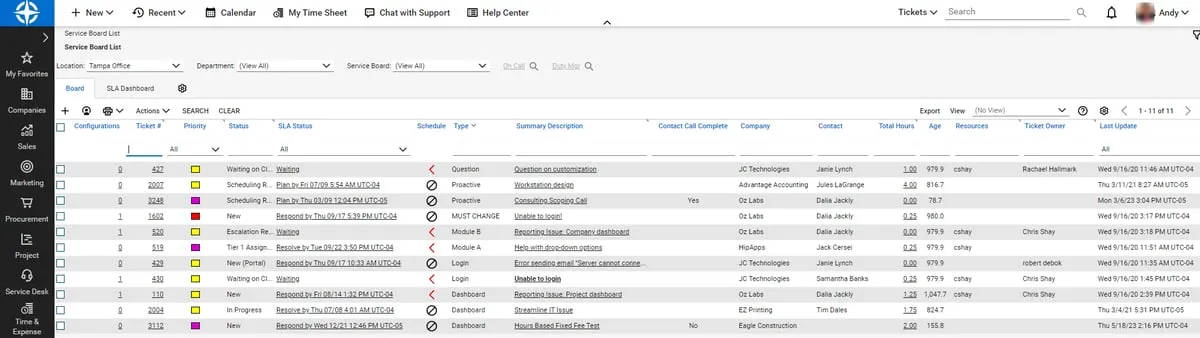
ConnectWise PSA, formerly ConnectWise Manage, is the incumbent. ConnectWise has been building it since 1982, and the feature set covers service desk, projects, time, billing, procurement, and CRM under one roof. The Asio platform ties PSA to RMM, Automate, ScreenConnect, backup, and security on a shared data layer, which removes the integration tax that best-of-breed stacks carry. Sidekick, the AI assistant in Teams, handles triage, record lookups, and admin clicks. It suggests rather than resolves, which is the gap Rallied fills for ConnectWise shops.
The depth is also the cost. The UI is complex, onboarding takes weeks, implementation partners charge thousands, and r/msp is full of shops that moved to HaloPSA because maintaining a ConnectWise instance became someone's job. Pricing needs a sales call; expect $65 to $140+ per user a month depending on bundle and term. Our ConnectWise Manage review and ConnectWise PSA pricing cover both.
How to choose
"Best MSP software" is a category question wearing a product question's clothes, so start with the layer you are filling.
If you need a PSA, HaloPSA for 10 to 50 techs and ConnectWise for 50+. Under 10 techs, the overhead of either rarely pays back, and our best PSA software comparison covers the lighter options.
If you need an RMM, NinjaOne if patching and polish matter most, N-central for a large complex estate with an admin to run it, Datto if you are already on Autotask. Our RMM automation guide covers what to automate first once the RMM is in.
If you want one bill for both, Atera for per-tech pricing and bundled AI, Syncro for a straightforward all-in-one with strong M365 depth, SuperOps if you are starting fresh.
If your PSA and RMM are settled and the queue is still full of password resets, Rallied adds the layer that closes them. It does not replace anything above it. The best AI tools for MSP ticket automation comparison covers the alternatives in that layer.
One pricing pattern to understand before signing anything:
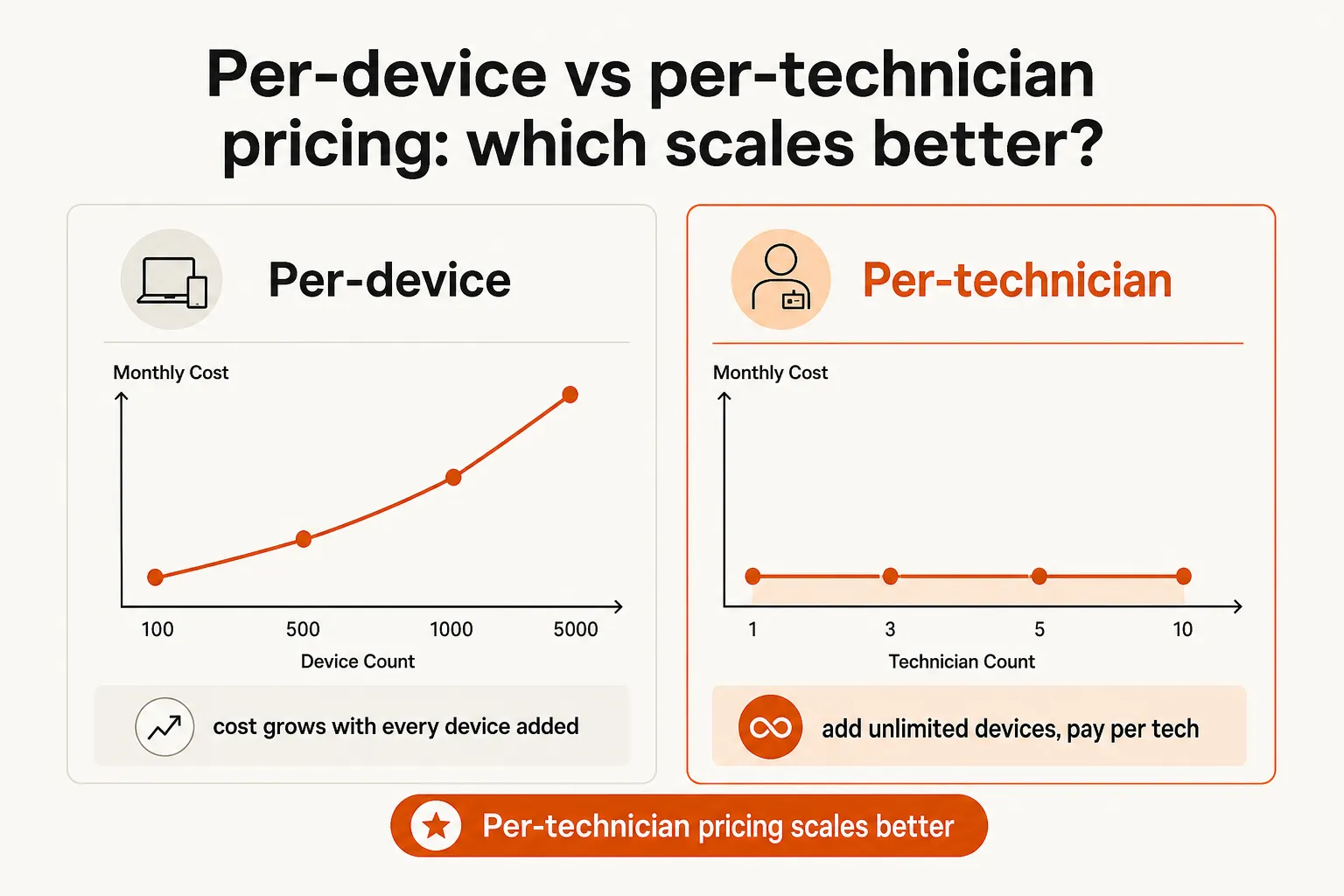
Per-device pricing (NinjaOne, Datto, N-able) grows with your endpoint count. Per-technician pricing (Atera, Syncro) grows only when you hire. Rallied's $150 monthly plan stays the same unless you buy extra credits. Which model wins depends on which of those numbers is growing fastest in your shop. The MSP ROI calculator takes your tech count, what each tech costs, and the share of their time on repetitive tickets, and shows what automating that share is worth, so you can check the math before you commit.
Frequently asked questions
What is MSP software?
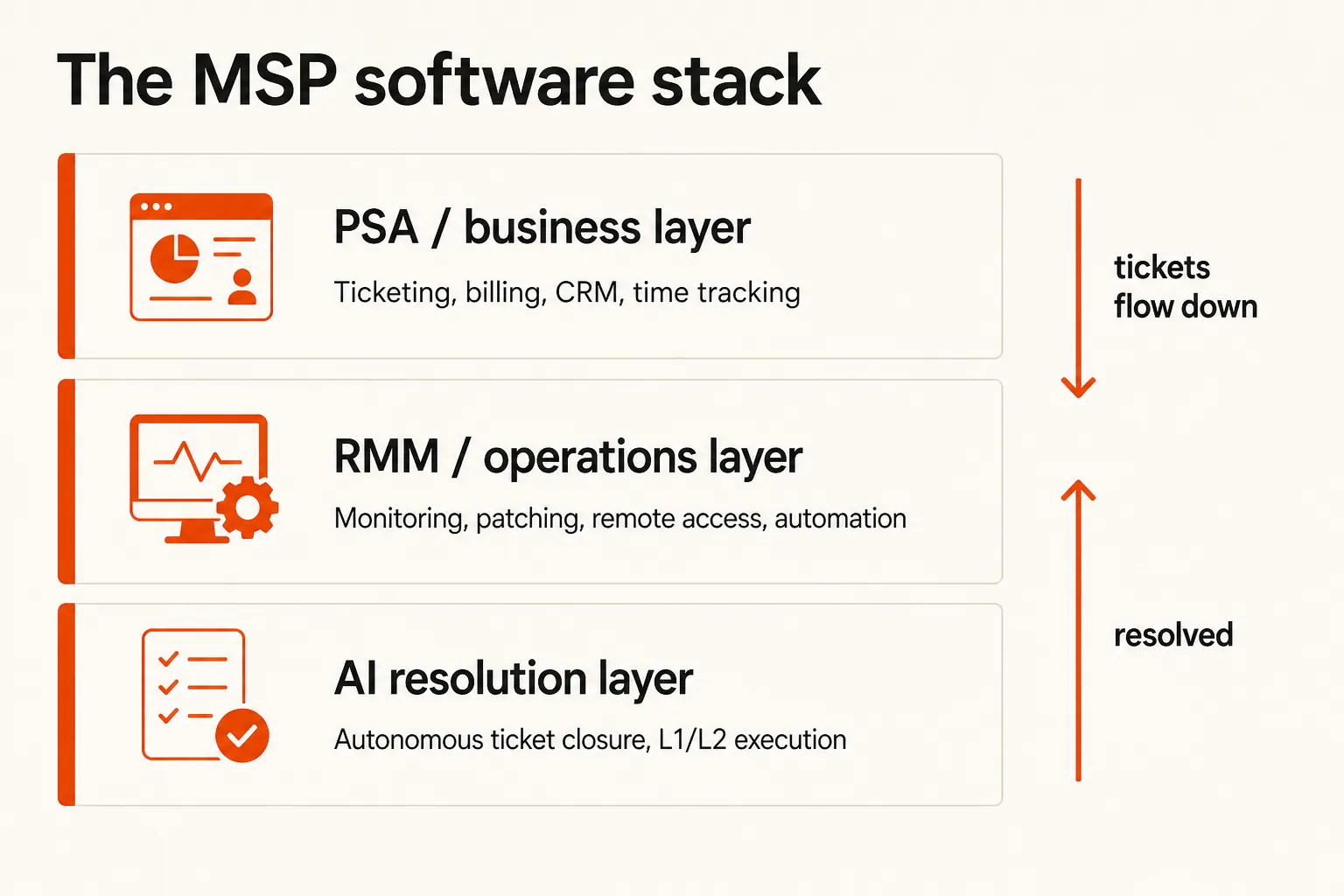
MSP software is the set of tools a managed service provider runs its business on. The core is a PSA for tickets, time, and billing, and an RMM for monitoring and managing client endpoints. Around those sit documentation (IT Glue, Hudu), security tooling, backup, and increasingly an AI layer that resolves routine tickets inside the PSA.
What is the difference between PSA and RMM?
The PSA runs the business: ticket boards, time entries, contracts, invoicing, and projects. The RMM runs the endpoints: monitoring, patching, scripting, and remote access. Some platforms (Atera, Syncro, SuperOps) combine both. Most larger MSPs run one of each and integrate them.
How much does MSP software cost?
Published prices in 2026 run from about $1.50 to $3.75 per device a month for RMM (NinjaOne), $35 to $109 per agent a month for PSA (HaloPSA), and $149 to $219 per tech a month for all-in-one platforms (Atera, Syncro). ConnectWise, Datto, N-able, and SuperOps are quote only. Rallied is $150 a month for 2,000 credits, about 700 tickets in a typical month.
Do I need an AI layer on top of my PSA and RMM?
Only if routine tickets are eating tech time your shop would rather bill. PSA-native assistants such as ConnectWise Sidekick suggest and summarise. A resolution layer runs the fix and closes the ticket. If your dispatcher can name the five ticket types that come in every day, that is the queue an AI layer is for.
What software do MSPs use?
Most MSPs run four kinds of tools. A PSA (ConnectWise PSA, HaloPSA, Autotask) holds tickets, time, contracts, and billing. An RMM (NinjaOne, Datto RMM, N-central, ConnectWise Automate) monitors and patches client endpoints and runs scripts. A documentation platform such as IT Glue or Hudu stores runbooks, credentials, and client notes. Backup and security tools sit alongside. Smaller shops often cover PSA and RMM with one all-in-one product like Atera, Syncro, or SuperOps, and a growing number add an AI agent such as Rallied to resolve routine requests inside the PSA they already run.
What is MSP software used for?
Day to day, it takes in client requests, gets them worked, and turns the time into invoices. The PSA converts emails and portal requests into tickets, puts them on a board, and records the time entries that billing runs from. The RMM watches client devices, raises alerts, pushes patches, and gives techs remote access and a place to run scripts. Reports from both feed the business reviews most MSPs hold with clients. Where an MSP has an AI layer, it handles the repetitive requests on that board, such as password resets, mailbox access, and new user setup.
What is an MSP platform?
"MSP platform" usually means an all-in-one product that combines PSA and RMM, so tickets, billing, monitoring, and remote access share one login and one client list. Atera, Syncro, and SuperOps are sold this way. The trade-off is depth. An all-in-one is simpler to buy and run, and larger MSPs tend to pair a dedicated PSA with a dedicated RMM for more control over contracts, dispatch, and scripting.
