Best Veeam alternatives for MSPs in 2026
The strongest Veeam alternatives for MSPs in 2026 are Acronis Cyber Protect for integrated security, Rubrik for zero-trust compliance, Druva for cloud-native simplicity, and Synology Active Backup for eliminating subscription fees. Each solves a different pain point, from per-VM licensing costs to deployment complexity, so the right pick depends on your client mix and how you bill.
Veeam still works for many environments. But per-VM licensing gets expensive when you manage dozens of client tenants, the management console requires multiple services and a SQL database, and CVE-2023-27532 (the vulnerability that let attackers bypass credential encryption) prompted federal authorities to issue an industry-wide warning. MSPs have reasons to look elsewhere.
This article compares seven Veeam alternatives with real pricing, user feedback, and an honest look at where each one fits an MSP's stack, and where it does not.
What to look for in a Veeam alternative for MSPs
Not every MSP runs the same client mix. These criteria separate the options that matter from the ones that waste your evaluation time.
The pricing model matters more than the sticker price. Veeam's per-VM licensing spirals when you manage 20 or more client environments. Some alternatives charge per TB, others per workload, others use perpetual licenses. Match the model to how you bill your clients.
Multi-tenant management is where most enterprise backup tools fall short for MSPs. You need per-client dashboards, tenant-level policies, and reporting you can hand to a client without editing a spreadsheet first.
PSA and RMM integration keeps backup alerts inside your ticket queue instead of a separate console. If the tool cannot push alerts into ConnectWise, Autotask, or HaloPSA, your techs spend their morning switching between windows. For MSPs already using AI-driven ticket triage, backup alerts that land in the PSA automatically save real time.
Deployment complexity varies a lot. Veeam requires multiple services, a SQL database, and significant setup. Agentless solutions deploy faster but may lack granularity at the endpoint level.
Ransomware protection is the baseline. Immutable backups, air-gapped storage, and anomaly detection are requirements, not add-ons.
One warning from an IT manager on EduGeek: "Backups in an IT infrastructure are like a power supply in a decent computer, the one item you must never skimp on."
Veeam alternatives compared at a glance
| Product | Starting Price | Deployment | Best For | Key Differentiator |
|---|---|---|---|---|
| Acronis | $85/workstation | On-prem/Cloud | Security-focused MSPs | AI-native cyber protection |
| Rubrik | ~$3,000/year | Cloud-native | Enterprises | Zero-trust architecture |
| Cohesity | Contact sales | Hyperconverged | Large scale | Web-scale architecture |
| Druva | Consumption-based | 100% SaaS | Cloud-first orgs | Zero infrastructure |
| Unitrends | $829/year | Appliance/Software | SMBs | All-inclusive pricing |
| IDrive | $69.65/year | Cloud | Small business | Unlimited users/devices |
| Synology | Hardware cost | On-premises | Cost-conscious | No subscription fees |
7 best Veeam alternatives for MSPs
1. Acronis Cyber Protect
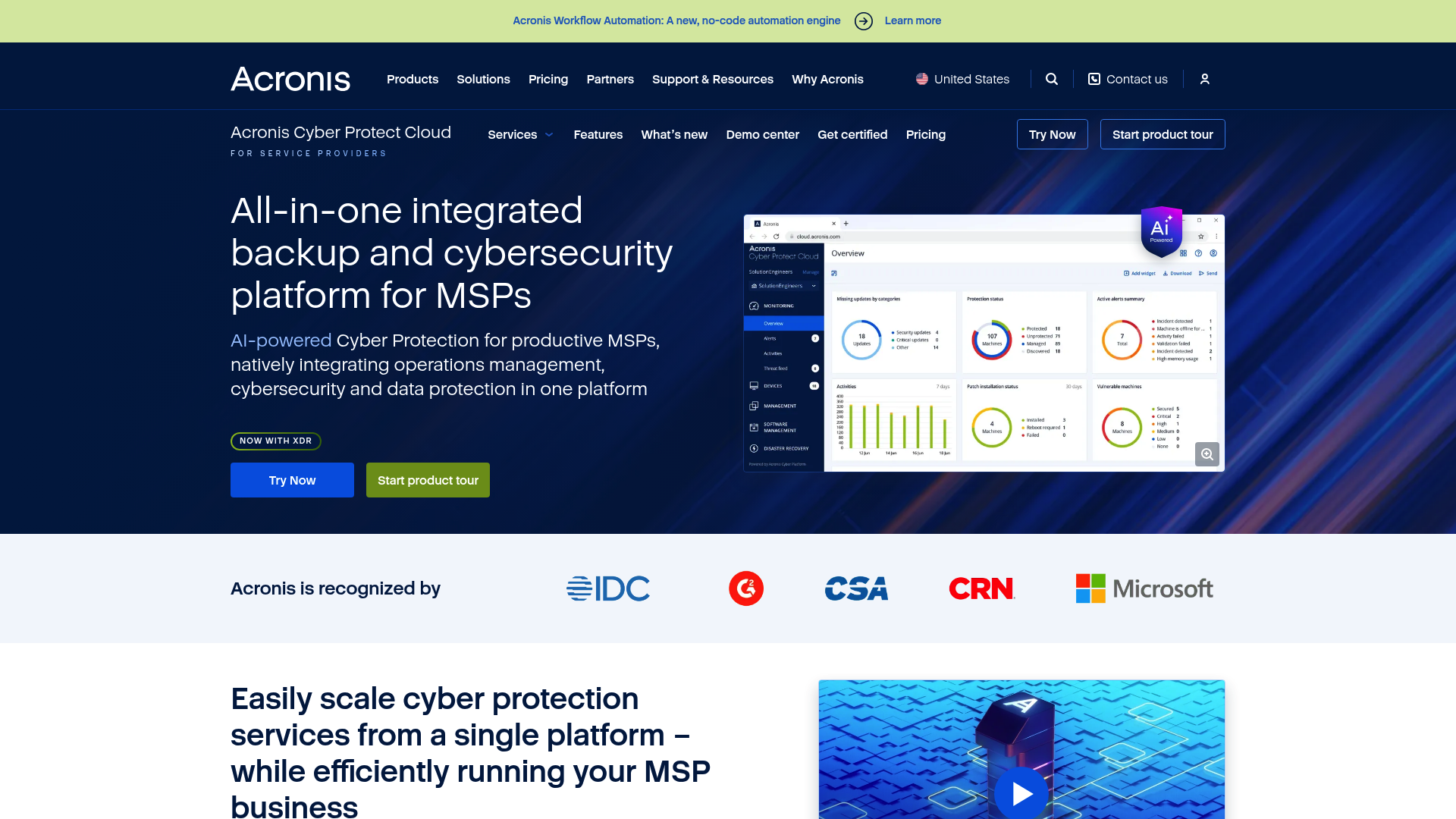
Acronis now positions itself as an AI-native cyber platform that combines backup with integrated cybersecurity in a single agent. For MSPs, the key selling point is one console covering both protection and security across client tenants.
Key features:
- AI-powered ransomware protection with behavioral detection
- Blockchain-based file notarization (Acronis Notary)
- Built-in anti-malware and antivirus
- VMware vSphere backup with 15-second RTO claims
- Microsoft Hyper-V and cross-platform support
Pricing:
| Tier | Workstation | Server | Virtual Host |
|---|---|---|---|
| Standard | $85 | $595 | $705 (unlimited VMs) |
| Advanced | $129 | $925 | $1,175 (unlimited VMs) |
Microsoft 365 and Google Workspace backup starts at $139 per instance.
Best for: MSPs wanting security and backup in one platform, especially those fielding ransomware-related backup and disaster recovery requests from clients.
Pros: Strong security integration, fast backup speeds, unified interface for protection tasks. Gartner Peer Insights rates Acronis 4.7 out of 5 from 415 ratings as a top Veeam alternative.
Cons: Resource-heavy agents, expensive at scale, limited SQL database support compared to specialized tools.
2. Rubrik
Rubrik built its reputation on security and simplicity. The platform uses a zero-trust architecture where no user or application is trusted by default. Everything is encrypted, immutable, and access-controlled. Rubrik is a 7x Gartner Magic Quadrant Leader and now emphasizes agentic cyber resilience, including AI-driven recovery orchestration.
Key features:
- Native immutable, append-only file system
- Machine learning-based ransomware detection
- Policy-driven automation for backup and retention
- Automated disaster recovery orchestration
- Compliance support for GDPR, HIPAA, PCI DSS
Pricing:
| Plan | Starting Price | Notes |
|---|---|---|
| Entry | ~$3,000/year | Small deployments |
| Enterprise | Custom | Based on data volume |
Rubrik does not publish standard pricing. Everything is customized, which means enterprise budgets only.
Best for: Enterprises and larger MSPs prioritizing security and compliance, organizations with zero-trust requirements.
Pros: Excellent ransomware protection, simple management interface, fast recovery times, no Windows dependencies.
Cons: Premium pricing puts it out of reach for most SMB-focused MSPs, limited customization options for backup policies.
3. Cohesity DataProtect
Cohesity uses a hyperconverged architecture that scales by adding nodes to a cluster. The company acquired Veritas's enterprise data protection business, making it one of the largest players in data protection. Cohesity has been named a Gartner Peer Insights Customers' Choice eight times in a row.
Key features:
- Web-scale, node-based cluster infrastructure
- Forever incremental backup after initial full
- Global deduplication across the cluster
- Instant DR failover for VMs and applications
- SaaS protection for Microsoft 365 and Salesforce
Pricing: Contact sales only. No public pricing available.
Best for: Large enterprises and MSPs needing massive scalability across complex multi-cloud environments.
Pros: Impressive scalability, user-friendly interface, simple setup for its capabilities, now includes Veritas technology.
Cons: Limited automation customization, rigid backup scheduling (cannot set specific calendar dates), database backups can be challenging. Not practical for smaller MSPs.
4. Druva
Druva is 100% cloud-native, so there is nothing to install or host: you point it at your workloads and it handles the rest. Druva backs its platform with a $10M resilience guarantee and reports a 93 certified NPS, which is unusually high for the backup category.
Key features:
- Pure SaaS architecture with no on-premises components
- Automatic updates with zero maintenance
- SaaS application protection (Microsoft 365, Salesforce, Google Workspace)
- Global deduplication reducing storage costs
- Cyber resilience with threat monitoring and forensic analysis
Pricing: Consumption-based. Contact sales for specific pricing.
Best for: Cloud-first MSPs and distributed teams wanting zero infrastructure overhead.
Pros: No infrastructure management, excellent customer support, fast deployment, automatic updates.
Cons: Cloud-only (no air-gapped options), ongoing subscription costs with no perpetual option, requires internet connectivity for all operations.
5. Unitrends
Unitrends focuses on simplicity and transparent pricing. They offer both physical appliances and virtual deployments with all features included in the subscription. For MSPs managing a handful of SMB clients, the all-inclusive model means no surprise costs on the monthly bill.
Key features:
- All-inclusive pricing covering backup, DR, and cloud archiving
- Integrated ransomware detection
- Automated disaster recovery testing (Recovery Assurance)
- Built-in cloud backup and archiving
- Centralized management for multi-site organizations
Pricing:
| Plan | Starting Price | Best For |
|---|---|---|
| Entry | $829/year | Small environments |
| Mid-market | Custom | Growing businesses |
| Enterprise | Custom | Appliance-based deployments |
Best for: SMB-focused MSPs wanting predictable costs, organizations needing simple all-in-one backup and DR.
Pros: Transparent pricing, easy cloud integration, good multi-site management, recovery assurance testing.
Cons: Less enterprise-grade than competitors, support quality varies, appliance options require hardware maintenance.
6. IDrive
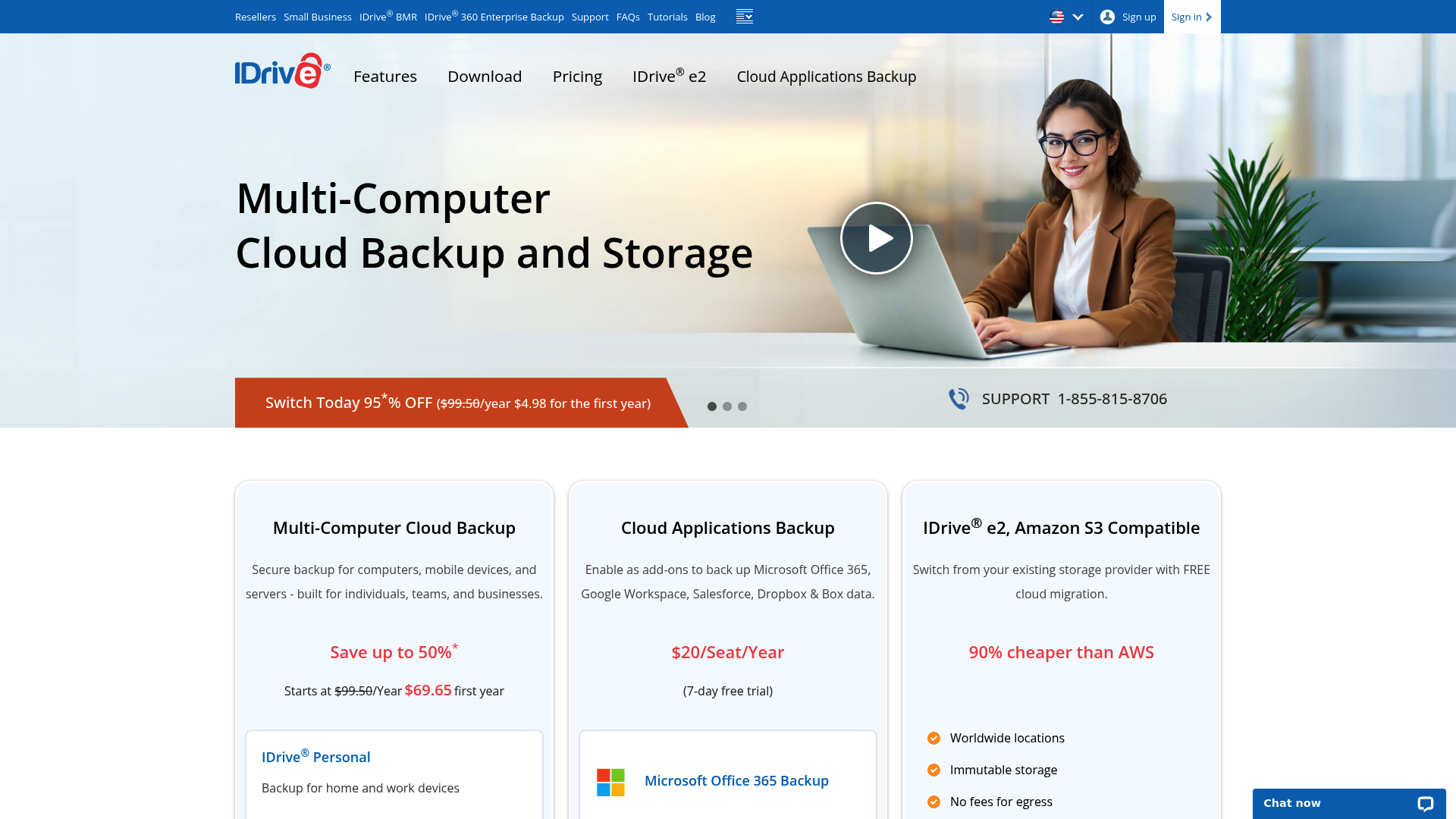
IDrive targets small businesses with aggressive pricing and simple deployment. Do not expect enterprise features, but for basic backup needs, the value is hard to beat.
Key features:
- Cross-platform backup (Windows, Mac, Linux, mobile)
- 256-bit AES encryption in transit and at rest
- Server backup including physical and virtual
- Disk image backup for full system recovery
- File sync across devices
- Courier recovery for large datasets (IDrive Express)
Pricing:
| Plan | Price | Storage | Users/Devices |
|---|---|---|---|
| Business Basic | $69.65/year | 250GB | Unlimited |
| Business Plus | $99.65/year | 500GB | Unlimited |
| Business Premium | $149.65/year | 1.25TB | Unlimited |
| Enterprise | Up to $999.65/year | 50TB | Unlimited |
All plans include unlimited users and devices. You pay for storage only.
Best for: Small MSPs or IT teams with limited budgets and moderate data volumes.
Pros: Very affordable entry point, unlimited users and devices, courier recovery option for large restores.
Cons: Limited enterprise features, slower support response times, not designed for complex multi-tenant environments.
7. Synology Active Backup
Synology takes a different approach. Instead of subscription software, you buy a NAS appliance once and get backup software included. No ongoing licensing fees. Synology was recognized as a Strong Performer in the 2026 Gartner Peer Insights Voice of the Customer for Backup and Data Protection Platforms, with an overall rating of 4.9 out of 5 from 55 reviews and 98% of reviewers saying they would recommend it.
Key features:
- License-free backup for unlimited workstations and servers
- Microsoft 365 and Google Workspace backup included
- VMware and Hyper-V protection with changed block tracking
- Immutable snapshots for ransomware protection
- Centralized management console
Pricing: Hardware-only. Entry-level NAS devices start around $300 to $500. Enterprise setups with dual appliances and 200TB+ run around $25,000, paid once rather than every year.
Best for: MSPs wanting to eliminate subscription fees, businesses preferring on-premises data control.
Pros: No subscription fees ever, license-free SaaS backup, reliable hardware, immutable snapshots included.
Cons: Large upfront capital investment, hardware requires maintenance and eventual replacement, scalability limited by hardware capacity.
How to choose the right Veeam alternative
A decision framework based on what we see working across MSPs and IT teams:
| Pick | When |
|---|---|
| Acronis | You want security and backup in one platform, and ransomware protection is a top priority across your client base |
| Rubrik | You have the budget, compliance is non-negotiable, and you need zero-trust architecture |
| Cohesity | You run at large-enterprise scale and have dedicated staff to manage it |
| Druva | You want zero infrastructure to manage and your clients are fully committed to cloud |
| Unitrends | You serve SMB clients and want predictable, all-inclusive pricing |
| IDrive | You are small, budget-constrained, and need basic backup that works without fuss |
| Synology | You want to drop subscription fees entirely and would rather own the hardware |
Gartner Peer Insights also lists Commvault (4.6 rating, 632 reviews) as a top Veeam alternative. It is worth evaluating if you run complex multi-cloud environments, though its licensing can be just as difficult to predict as Veeam's.
Switching from Veeam: what to expect
Plan for a 30 to 90 day transition period. You will need to run both systems in parallel, test restores from the new solution, and retrain staff on the new interface.
Do not cancel Veeam until you have verified the new solution actually works for your environment. Test recovery scenarios that matter to your business, not the ones the vendor demos.
For a broader view of the tools MSPs are running alongside their backup stack, see Best MSP Software in 2026 and Best Enterprise Backup Software for MSPs.
Frequently Asked Questions
What is the most affordable Veeam alternative for a small business?
IDrive starts at $69.65 per year for 250GB with unlimited users and devices. For on-premises needs, Synology requires a one-time hardware investment but eliminates ongoing subscription costs entirely. Both are best suited for small environments with moderate data volumes.
Which Veeam alternative offers the best ransomware protection?
Rubrik and Acronis both lead on ransomware protection. Rubrik uses a zero-trust architecture with native immutable backups and has been named a Gartner Magic Quadrant Leader seven times. Acronis integrates AI-based behavioral detection with backup in a single agent.
Are there any Veeam alternatives with no subscription fees?
Synology Active Backup has no subscription fees. You pay for the NAS hardware once and the backup software is included free with DSM. Synology was recognized as a Strong Performer in the 2026 Gartner Peer Insights for Backup and Data Protection Platforms.
What Veeam alternative is best for cloud-first MSPs?
Druva is 100% cloud-native with no infrastructure to manage. It covers Microsoft 365, Salesforce, and Google Workspace, and backs its platform with a $10M resilience guarantee. The trade-off is no air-gapped or on-premises option.
How does Veeam alternative pricing compare for enterprise deployments?
Enterprise pricing varies significantly. Rubrik starts around $3,000 per year for small deployments. Cohesity and Druva require custom quotes. Acronis scales per workload. For large environments, get quotes from at least three vendors because pricing models differ enough to change the total cost by 2x or more.
Can I migrate from Veeam without losing my backup history?
Backup history generally does not transfer between platforms. You will maintain Veeam archives for retention compliance while building new backup history on the alternative. Plan for 30 to 90 days of running both systems in parallel and test real restore scenarios before decommissioning Veeam.
What is the best Veeam alternative for MSPs specifically?
It depends on your client mix. Acronis works well for MSPs that want security and backup in one console. Unitrends suits SMB-focused MSPs wanting predictable all-inclusive pricing. Druva fits cloud-first MSPs. The key MSP criteria most enterprise backup tools miss are multi-tenant management and PSA or RMM integration.
