Kaseya VSA vs NinjaOne: which RMM should your MSP use in 2026?

TL;DR
For most MSPs -- especially those under 300 endpoints who value simplicity, transparent pricing, and fast time to value -- NinjaOne is the cleaner pick. It leads Kaseya on every G2 dimension, has held the #1 RMM ranking for four consecutive years, and gets the average customer fully deployed in under a week.
Kaseya VSA (now sold primarily as Kaseya 365 Endpoint at ~$3.99/endpoint/month per case study data) makes more sense if you're managing 500+ endpoints, already deep in the Kaseya ecosystem, and have the admin bandwidth to unlock serious automation depth.
One thing worth knowing before you pick either: both tools are fundamentally passive. They monitor, alert, and surface work -- but the remediation still lands on a human. If your goal is to reduce the ticket queue itself, you'll need something on top of either platform. We'll come back to that.
What is Kaseya VSA?
Kaseya VSA is one of the oldest RMM platforms in the MSP market. The current version -- VSA 10 -- is cloud-based and sold almost exclusively as part of the Kaseya 365 Endpoint bundle, which combines RMM, patch management, antivirus (Datto AV), endpoint detection and response (Datto EDR), endpoint backup, and optional managed detection and response (RocketCyber MDR/SOC) into a single per-endpoint subscription.
VSA 9, the previous major version, is no longer available for new customers. Existing VSA 9 users have a migration path to VSA 10 or to Datto RMM (also Kaseya-owned).
The platform's biggest strength has always been automation depth. The scripting library is extensive, policy-based automation can scale across thousands of endpoints, and the Kaseya 365 bundle ships with 20 built-in cross-product automations out of the box. For larger MSPs already running IT Glue, Datto backup, and BMS, the integration value within the Kaseya family is genuinely compelling.

One customer quote that captures the 365 bundle's appeal: "The sheer concept of a single, low-cost subscription to manage, secure and back up every single endpoint for our clients was mind-blowing." -- Two River Technology Group, on Kaseya 365 Endpoint.
There is one thing any honest Kaseya evaluation has to include: the July 2021 REvil ransomware supply-chain attack via a Kaseya VSA vulnerability compromised hundreds of MSP customers and thousands of their end clients. Kaseya has invested in security improvements since -- the incident is five years old now -- but it still surfaces in evaluation conversations, and it's fair to ask about it.
What is NinjaOne?
NinjaOne is a cloud-native unified IT operations platform: RMM, patch management, backup, remote access, ticketing, and IT documentation in one console. It launched as a simpler, more modern alternative to legacy RMM platforms, and that positioning has held: it's now the #1-rated RMM on G2 for four consecutive years and a Gartner Magic Quadrant Leader for Endpoint Management as of 2026.
NinjaOne's pitch is consolidation -- replace 10-15 tools with one platform -- combined with fast time to value. Most customers are fully deployed in under a week, with an average learning curve under three hours. It supports Windows, macOS, Linux, iOS, and Android, managing up to 150,000+ endpoints on the same cloud architecture.

Support is worth calling out separately. NinjaOne scores 9.3 on Quality of Support on G2 -- the highest of any RMM -- with a 98+ CSAT score and free unlimited support for all customers. When you're relying on a platform every day, that backup matters more than most people model for when evaluating.
Kaseya VSA vs NinjaOne: pricing
Both platforms use per-endpoint/device pricing, and neither publishes a full public rate card. But real data exists on both sides.

NinjaOne pricing ranges from $1.50/device/month at 10,000+ endpoints to $3.75/device/month at 50 or fewer. No setup fees, no training charges, no professional services required for onboarding. Free unlimited support is included at every tier. A 14-day free trial is available, and longer commitment terms unlock lower per-device rates.
Kaseya VSA / Kaseya 365 Endpoint operates on a contact-sales model with no public rate card. The most concrete real-world data comes from a Kaseya case study showing Ergon Consulting reduced their cost from $14.50/endpoint to $3.99/endpoint/month after moving to the Kaseya 365 bundle. Kaseya claims up to 70% savings versus comparable point-solution stacks. There's a 50-endpoint minimum for new customers, and the bundle includes 5TB backup storage with overage charges above that.
| Kaseya VSA / 365 | NinjaOne | |
|---|---|---|
| Confirmed pricing | ~$3.99/endpoint/mo (bundle, per case study) | $1.50-$3.75/device/mo |
| Pricing model | Contact sales | Tiered, quote available |
| Minimum | 50 endpoints | No minimum |
| Free trial | 14 days | 14 days |
| Setup fees | Professional services may apply | None -- free |
| Support | Standard included | Free unlimited, 98+ CSAT |
| Backup storage | 5TB included (365) | Add-on |
For a 100-endpoint shop, NinjaOne likely lands in the $2.50-$3.25/device range -- potentially competitive with Kaseya's bundle once you account for what's included on each side. The core difference is predictability: NinjaOne gives you a range to model against before you talk to anyone; Kaseya requires a sales call before you see a number.
Kaseya VSA vs NinjaOne: features and automation
Both platforms cover the RMM fundamentals -- endpoint monitoring, patch management, remote access, alerting, scripting. Where they diverge is depth versus simplicity.
Kaseya VSA has a more extensive scripting library and more granular policy-based automation controls. The workflow builder is genuinely powerful: trigger-condition-action chains that can handle sophisticated multi-step remediations. For MSPs who want to build complex, custom automation, VSA has more headroom. The Kaseya 365 bundle ships with 20 built-in cross-product automations across RMM, AV, EDR, and backup -- a meaningful shortcut for shops already in the Kaseya ecosystem.

"I cannot tell you how many hours we've saved on small simple tasks. Now, we can focus our attention on bigger, more critical tasks." -- Kyle Tennyson, Spectrum Data Networks, via Kaseya case studies
NinjaOne patches 6,000-8,800+ third-party applications across Windows, macOS, and Linux -- one of the broadest patch libraries in the category. Its AI-powered patch intelligence flags unstable patches before they roll out, and deployment is 30% faster than competing solutions by design. The platform delivers 95% time savings on manual tasks and a 94% reduction in ticket volumes per its customer data. Flash migrated 20,000+ endpoints in under three months with zero end-user downtime -- a good benchmark for what the automation layer can handle at scale.
Where Kaseya wins: scripting depth, the all-in-one bundle value for shops already in the Kaseya family, Cooper AI for workflow generation.
Where NinjaOne wins: patch breadth, AI-assisted patching, faster out-of-the-box deployment, cleaner automation for most use cases.
Kaseya VSA vs NinjaOne: ease of use
This is where the gap is widest -- and it shows up consistently in G2 data and community discussions.
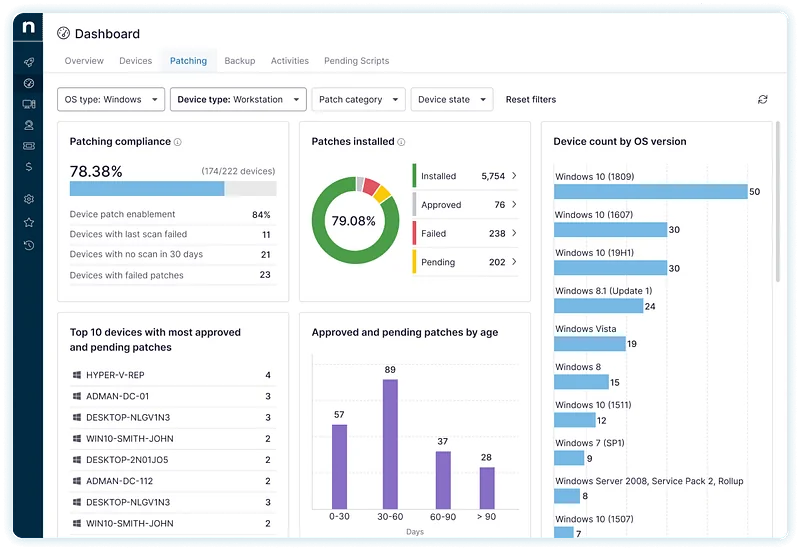
NinjaOne scored 9.3 on Ease of Admin on G2 -- the highest of any RMM in the category. Customers describe an average learning curve under three hours and full deployment in under a week. Bridget Bonin, IT Endpoint Engineer, put it directly in her G2 review: "The dashboard is clean and powerful, giving us real-time visibility into device health, compliance and performance."
Kaseya VSA scored 8.2 on Ease of Admin on G2. Solid, but a full point behind NinjaOne. The learning curve is steeper. VSA's depth is the same attribute that makes it harder to learn: the scripting library rewards expertise, the policy hierarchy requires practice to configure correctly, and the VSA 9 to VSA 10 migration has added friction for existing users. Reddit's r/msp consistently flags NinjaOne as the cleaner pick for smaller and mid-sized shops specifically because of this setup complexity difference.
For a multi-tech shop with a dedicated RMM admin, that gap matters less. For a two-person MSP, it's often the deciding factor.
Kaseya VSA vs NinjaOne: integrations
Both platforms connect deeply with PSA, documentation, identity, and security tools. The integration lists are similar at the surface, but the ecosystem gravity is different.
NinjaOne supports 40+ deep integrations: ConnectWise, Autotask, Accelo, and HaloPSA on PSA; Okta, Entra ID, and OneLogin on identity; CrowdStrike, SentinelOne, and Bitdefender on security; IT Glue, Passportal, and Liongard on documentation; Rewst and ImmyBot for workflow automation. Clean API with strong integration reliability ratings across reviews.
Kaseya VSA / 365 integrates with the same core set (ConnectWise, Autotask, Halo, IT Glue, Hudu, Entra ID, Okta, JumpCloud), but the bigger story is vertical integration within the Kaseya family itself. Kaseya 365 includes Datto RMM, Datto AV, Datto EDR, Datto backup, and optional RocketCyber SOC -- all tightly integrated. As Larry Robertson of MERIT Solutions noted: "The way the three tools -- VSA, BMS and IT Glue -- are integrated and work with one another gives our team a great toolset to boost efficiency."
If your stack is Kaseya-heavy -- IT Glue, BMS, Datto products -- staying on VSA is a rational choice. If you're building a best-of-breed stack from scratch, NinjaOne plugs in cleanly wherever you are.
What the community says
The G2 numbers tell a consistent story.

| Dimension | NinjaOne | Kaseya VSA |
|---|---|---|
| Ease of Admin | 9.3 | 8.2 |
| Quality of Support | 9.3 | 7.7 |
| Device Management | 9.3 | 8.6 |
| Remote Monitoring | 9.4 | 8.8 |
| Patch Management | 9.1 | 8.4 |
| Overall Average | 9.3 | 8.4 |
Source: G2 Summer 2026 RMM category
The support gap stands out most: 9.3 vs 7.7. NinjaOne's free unlimited support is a recurring theme in reviews as a reason MSPs stay. Kaseya's support, while improved post-VSA 10, still draws complaints about response time and ticket resolution quality in community discussions.
The 2021 REvil attack still surfaces in MSP evaluation conversations. The supply-chain attack via a Kaseya VSA vulnerability compromised hundreds of MSP customers and thousands of end clients. Kaseya has made security investments since -- the event is five years old -- but first-time evaluators still ask about it, and that's a fair question to raise.
Analyst recognition also breaks clearly in NinjaOne's direction. NinjaOne is a Gartner Magic Quadrant Leader for Endpoint Management and a Gartner Peer Insights Customers' Choice for 2026. An IDC study found 720% ROI over three years and $200K+ annual savings documented across customer organizations.

Reddit's r/msp sentiment tracks the G2 data: NinjaOne is the default recommendation for small-to-mid shops; Kaseya VSA or Datto RMM gets the nod for larger deployments where automation depth matters more than simplicity. Large MSPs with 500+ endpoints -- where the scripting investment pays off -- tend to stick with Kaseya; shops with fewer than 200 endpoints tend to prefer NinjaOne's lower friction.

Who should pick Kaseya VSA?

Kaseya 365 Endpoint makes the most sense if:
- You're already in the Kaseya ecosystem. If you're running IT Glue, BMS, or Datto products, switching has a real cost and the integration value within the Kaseya family is genuine.
- You manage 500+ endpoints and need automation depth. The scripting library and policy-based automation give larger shops headroom that NinjaOne's more streamlined interface doesn't reach. One partner reported a 75% efficiency improvement after properly configuring VSA 10 automation.
- You want a bundled all-in-one stack. Kaseya 365 at ~$3.99/endpoint bundles RMM, AV, EDR, and backup. For shops paying separately for four point solutions, consolidating can genuinely reduce total cost, as the Ergon Consulting case study shows.
- You have admin bandwidth for configuration. VSA rewards investment. A dedicated admin who knows the scripting environment can build sophisticated automation that the platform's depth makes possible.
Our take: Kaseya VSA in 2026 is not the expensive, unwieldy incumbent it was in 2020. The 365 bundle has made it more competitive, and VSA 10 is more usable than VSA 9. But it still earns its value through configuration -- and it asks more from you upfront than NinjaOne does.
Who should pick NinjaOne?
NinjaOne is the cleaner choice for most MSPs. The numbers back it up across every category.
Pick NinjaOne if:
- You're managing under 300 endpoints or scaling quickly. Tiered per-device pricing and fast onboarding mean you can start small and grow without renegotiating or hitting commitment floors.
- Transparent pricing matters. $1.50-$3.75/device/month depending on scale, no setup fees, no hidden training charges. You can model your costs before you talk to anyone.
- Time to value is real pressure. Under one week to full deployment, under three hours average learning curve. If you're replacing a legacy RMM mid-sprint, NinjaOne's onboarding is genuinely fast.
- Support quality is a dealbreaker. Free unlimited support, 98+ CSAT, highest-rated support in the category. For a small team that can't afford to wait on a support ticket, that matters.
- Patch coverage is the priority. 6,000-8,800+ third-party applications, AI-powered patch intelligence, 30% faster deployment than alternatives. Patch management is the core vulnerability surface for most MSPs, and NinjaOne's is best in class.
Our take: NinjaOne is what an RMM should look like in 2026. It leads on every G2 dimension, deploys fast, doesn't charge for support, and has the analyst recognition to back the claims. For most MSPs evaluating for the first time, it should be the starting point.
The one gap neither tool closes
Here's what the Kaseya vs NinjaOne debate mostly sidesteps: both platforms are fundamentally passive.
They monitor your endpoints. They alert when something breaks. They make the work visible. But when a ticket lands -- a password reset, an account unlock, an employee onboarding -- a human still has to go resolve it. NinjaOne automates patch deployment. Kaseya VSA automates remediation workflows. Neither one actually closes a helpdesk ticket on its own.
The math on that gap compounds quickly. For a typical MSP with 200 tickets/month, 40-60% tend to be routine L1 work. At 15 minutes per ticket, that's 20-30 hours/month of tech time -- often your most experienced technicians, handling work that's genuinely automatable. The RMM tells you the issue exists. Somebody still has to fix it.
That's the gap Rallied is built for.
Try Rallied
Rallied is an AI technician built specifically for MSPs. It connects to your PSA (ConnectWise, Autotask, Halo), RMM (NinjaOne, Datto/Kaseya), and identity stack (Entra ID, Okta, JumpCloud, Google Workspace) and autonomously handles L1 and L2 ticket work: password resets, account unlocks, MFA issues, user onboarding and offboarding, software installs.
It doesn't replace your RMM -- it sits on top of it and does the remediation that currently lands on your techs.
Most shops see 50-100 hours/month recovered -- the equivalent of $7K-$15K/month in tech time at standard MSP billing rates. Rallied is $150 a month for 2,000 credits, about 700 tickets in a typical month. Tickets it can't finish are never charged. Deployment takes under a week, with no 6-month implementation or dedicated admin overhead required.
If you're already evaluating which RMM to run -- or just switched -- it's worth asking what the stack looks like when your RMM actually closes tickets, not just alerts on them.
For the wider picture, read Best MSP Software in 2026.
Frequently Asked Questions
Is NinjaOne cheaper than Kaseya VSA?
Generally yes. NinjaOne's per-device pricing starts at $1.50/device/month at 10,000+ endpoints and tops out at $3.75/month for smaller deployments -- no setup fees, no training charges, no surprise invoices. Kaseya VSA's bundled Kaseya 365 Endpoint is confirmed at $3.99/endpoint/month based on customer case studies, but it's sold through a contact-sales model with a 50-endpoint minimum, making direct comparison hard without a call.
Which RMM has better G2 ratings -- Kaseya or NinjaOne?
NinjaOne leads clearly. NinjaOne scores 9.3 overall on G2 and has held the #1 RMM ranking for four consecutive years. Kaseya scores 8.4 overall, with its biggest gap in Quality of Support (7.7 vs NinjaOne's 9.3). Both hold G2 Leader status, but NinjaOne's margin is substantial across every dimension in the G2 RMM category.
Can I still buy Kaseya VSA 9?
No. VSA 9 is no longer available for new purchases. Kaseya now pushes new customers to VSA 10, sold primarily as part of the Kaseya 365 Endpoint bundle. Existing VSA 9 customers can migrate on their own schedule, but the forward path is VSA 10 or Datto RMM (also Kaseya-owned).
Which RMM is easier to set up for a small MSP?
NinjaOne, by a wide margin. NinjaOne's average learning curve is under three hours and full deployment takes under a week, with no professional services required. Kaseya VSA's depth is also its barrier -- the scripting library, policy management, and multi-product bundle all require more ramp time and often professional services for complex environments.
What if I want my RMM to actually resolve tickets automatically?
Neither Kaseya VSA nor NinjaOne resolves tickets on their own -- they monitor and alert, but humans still do the remediation. Rallied is built to close that gap: it connects directly to your PSA and RMM and autonomously handles L1/L2 tickets like password resets, account unlocks, and user onboarding. It works alongside either platform and typically recovers 50-100 hours/month of tech time for $150 a month, which includes 2,000 credits (about 700 tickets in a typical month).
