ConnectWise AI in 2026: What Sidekick and AI Agents Actually Do
TL;DR
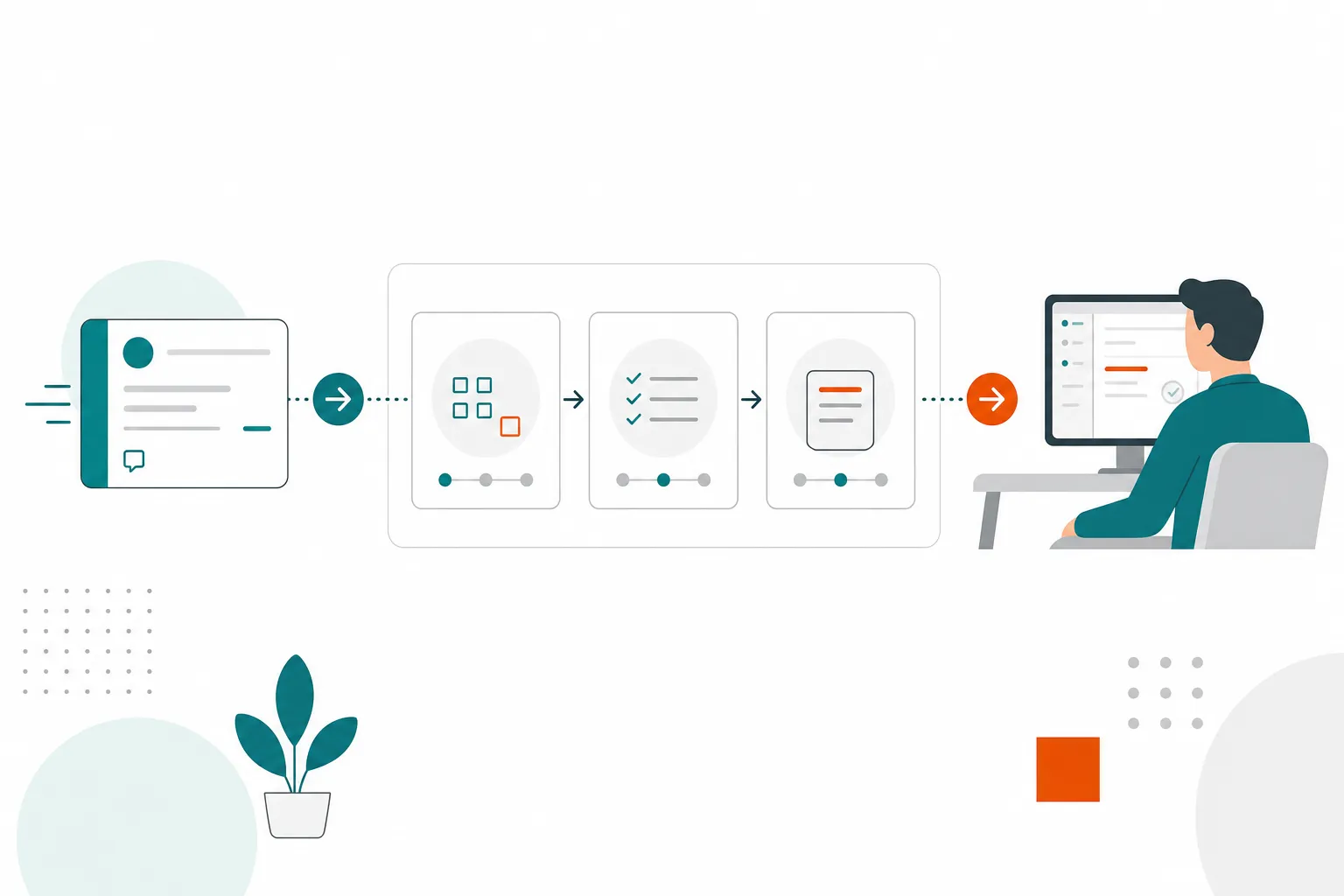
ConnectWise has released two overlapping AI product lines: Sidekick (embedded AI features across PSA, RMM, and Security) and AI Agents (four purpose-built agents: Service Desk, Triage, Data Analyst, and Oversight). Both are positioned as transformative. Both operate on a human-in-the-loop model - every suggestion, draft, and script needs a technician to review and approve before anything happens. The community verdict ranges from "decent for triage" to "nearly useless, we cancelled after a year." The marketing claims 80%+ reduction in escalations. The Reddit threads tell a different story. This post breaks down what's actually there, where the gaps are, and what "AI-assisted" means in practice when you're running tickets at volume.
What Is ConnectWise AI?
ConnectWise AI is the umbrella for everything the company has shipped under the "intelligent automation" banner since 2023. The flagship offering is Sidekick - launched with fanfare as "the world's first purpose-built AI companion for MSPs." The newer layer is AI Agents, a rebranding and expansion that carves Sidekick's capabilities into four named agents.
The elevator pitch is solid: stop burning tech time on grunt work, let AI handle classification, drafting, and analysis so your team focuses on things that actually need a human brain. ConnectWise is the dominant PSA platform for mid-market MSPs, so embedding AI directly into the workflow is a genuinely smart distribution play.
But distribution and capability are different things. Let's look at what's actually in the box.
Sidekick for PSA: Where Most of the Action Is
The most mature piece of the ConnectWise AI story lives in Sidekick for PSA, embedded in ConnectWise Manage. ConnectWise lists 70+ AI-assisted actions - here's what that looks like in practice.
Ticket summarization. Multi-threaded tickets with 40 notes and four technicians touching them get condensed into a digestible summary. Real time-saver when a ticket's been open for two weeks and someone new is picking it up.
Auto-triage. Incoming tickets get classified automatically - service board, priority, type, subtype, item fields. Less dispatcher overhead on standard inbound volume.
Email response generation. Based on ticket context and your knowledge base, Sidekick suggests a customer-facing reply. Technician reviews it, edits it if needed, then sends.
Ticket translation. Auto-translates tickets in and out of multiple languages. Useful for MSPs with multilingual client bases.
Customer sentiment tracking. Analyzes ticket language to infer whether a customer is frustrated or at-risk. Flags relationships before they churn.
Business opportunity insights. When a ticket context suggests an upsell (password reset from someone on a lower-tier plan, for instance), Sidekick surfaces the signal.
Microsoft Teams bot. The Teams integration is a meaningful UX win - technicians can access PSA records and AI suggestions from Teams on mobile or desktop without opening the web app.
One thing to be clear about: all AI-generated responses require human review before they reach customers. This isn't a limitation of the current version - it's a design choice. ConnectWise calls it human-in-the-loop. In practice, it means every suggested reply is a draft, not a send.
Sidekick for Automate: Scripts Without the Syntax Headache
The RMM variant focuses on one thing: script generation. Technicians describe what they need in plain English, Sidekick generates the PowerShell, batch, or bash script, and a technician reviews and approves before execution.
The pitch is "minutes to deployment" versus hours of manual authoring. For shops where scripting is a bottleneck - either because senior techs are the only ones who can write PowerShell, or because there just aren't enough hours in the day - this is a genuine time-saver.
The same human-approval requirement applies here: no AI-generated script executes without technician sign-off. Which is the right call. You don't want autonomous script execution without a review gate. But it does mean the time savings are in drafting, not in removal of the human from the loop.
Sidekick for Control: Security Gets AI Too
Launched mid-2024, Sidekick for Security brings natural-language querying to ConnectWise Control. Instead of navigating complex security dashboards, technicians ask questions in plain English: "Which endpoints haven't had AV definitions updated in 30 days?" Sidekick answers.
It also handles security ticket triage, surfaces threat intelligence trends across the customer environment, and recommends common remediation actions - isolation, patching, credential rotation.
For MSPs that are stretched thin on security operations, reducing alert fatigue is legitimately valuable. But the same caveat applies: recommendations, not autonomous execution.
The Four AI Agents
The newer AI Agents layer reframes Sidekick's features into four purpose-built agents. ConnectWise's own page at connectwise.com/ai-agents positions these as the evolution - from "AI-assisted copilot" to something more operational.
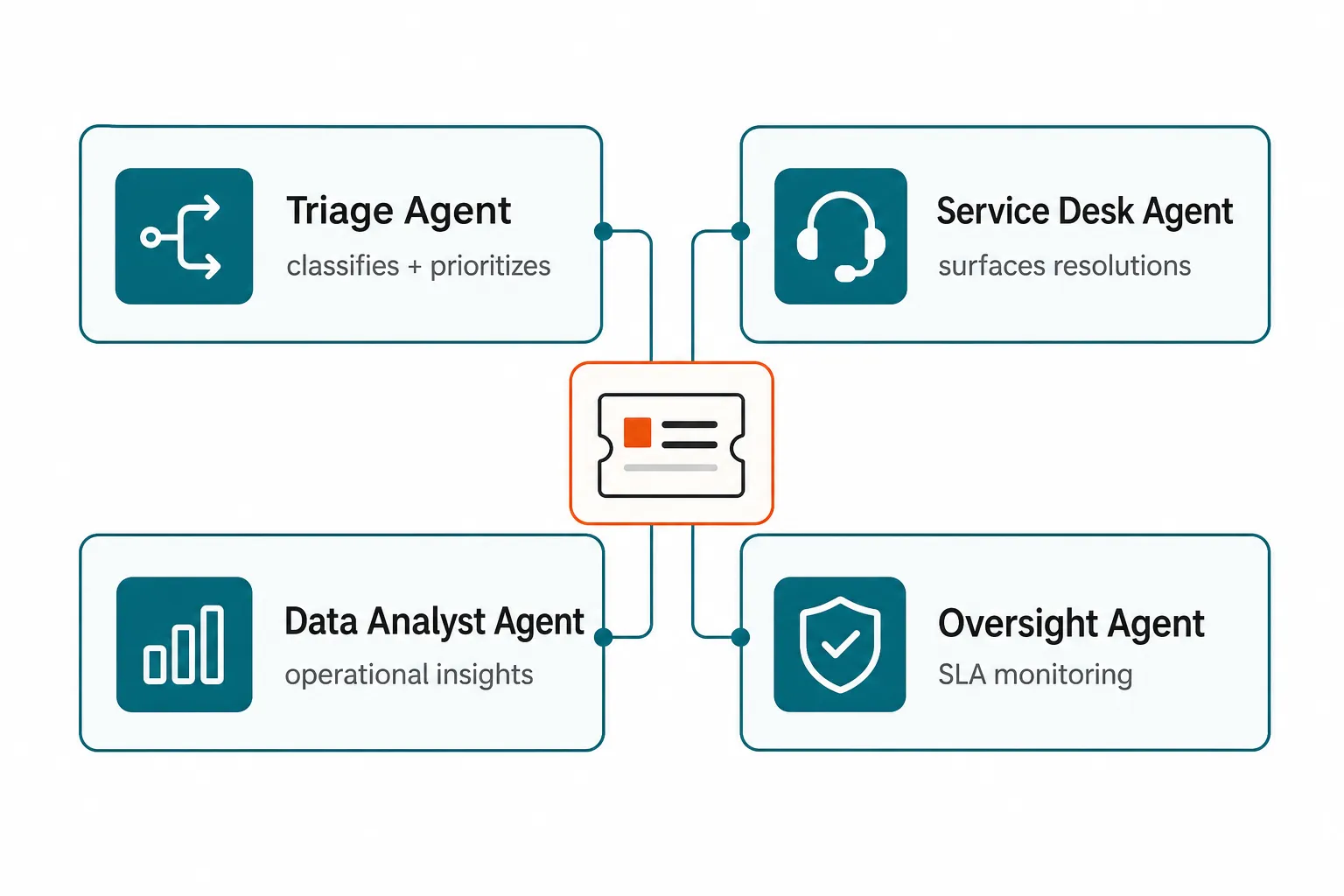
Service Desk Agent. Provides contextual intelligence to technicians - surfaces relevant resolutions, learns from successful outcomes, and improves over time as your team uses it. It's the "smarter suggest" layer.
Triage Agent. Automates ticket classification, labeling, prioritization, and routing. The key differentiator ConnectWise claims here is that it learns from historical PSA data rather than relying on manually defined rules. Less brittle than Flows-based automation, in theory.
Data Analyst Agent. Turns operational data into answers via natural-language queries. Ask questions across PSA, RMM, and financial data without writing a custom report. "How many tickets did we close last month with an SLA breach?" - you type it, the agent answers.
Oversight Agent. Monitors agent-driven workflows for quality, accountability, and SLA compliance. It's the meta-layer: watching what the other agents are doing and flagging service quality issues before they escalate to customer complaints.
ConnectWise claims the combined result is "80%+ reduction in escalations," "25% increase in first-touch resolution," and "up to 60% improvement in ticket throughput." The sourcing for these figures is the company's own platform page, not independent audit. Worth noting.
The Autonomy Ladder: Where ConnectWise Actually Sits
ConnectWise has published a clear framework for thinking about AI autonomy levels - which is genuinely useful, and which also honestly locates where Sidekick and the AI Agents currently sit.
- Level 1: AI-assisted - agent recommends, human decides
- Level 2: Human-in-the-loop - agent prepares the action, human approves
- Level 3: Autonomous execution - agent executes within guardrails, escalates exceptions
- Level 4: Agent orchestration - multiple agents coordinate multi-step workflows
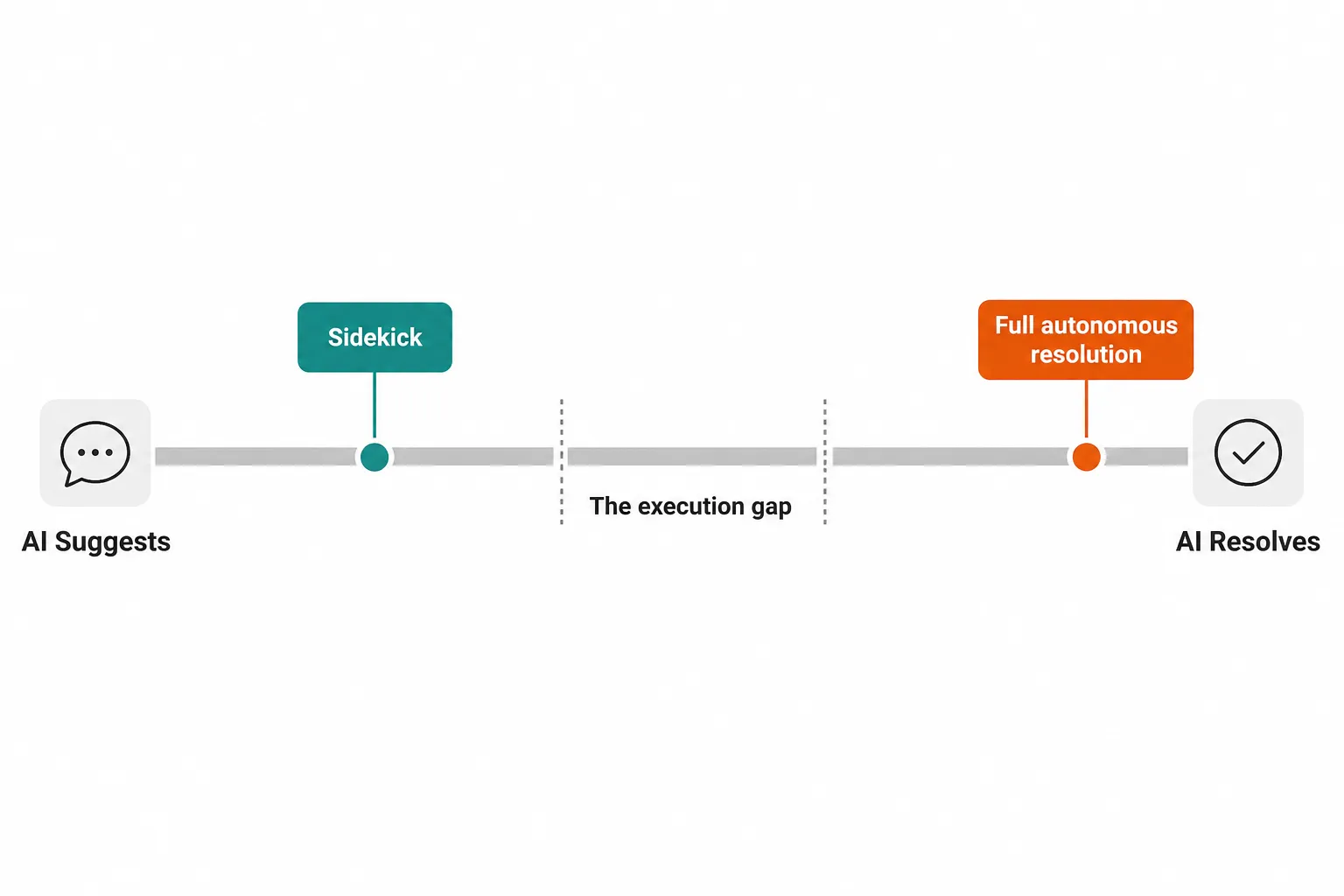
Most of ConnectWise AI operates at Levels 1-2. Sidekick for PSA primarily suggests and drafts. Sidekick for Automate generates scripts that need approval. The AI Agents provide classification, routing suggestions, and data answers - not autonomous ticket resolution.
ConnectWise's roadmap points toward Level 3-4 (their acquisition of zofiQ signals investment in execution capabilities), but that's forward-looking. In 2026, if you need autonomous execution today, you're looking at a platform that has built compelling infrastructure for the assist layer - not the resolution layer.
What the MSP Community Actually Thinks
ConnectWise's marketing is polished. The community feedback is more honest.
Across Reddit threads in r/ConnectWise and r/msp, the recurring themes are disappointment, low adoption, and a specific pattern of "we tried it, stopped using it within weeks."
"Hey, I work at an MSP and we used Sidekick for about a year. We cancelled it as literally none of us used it. The responses it gave was nearly almost useless and we all stopped using it within in a couple weeks." - FreddieFarnfield, Reddit
The Chief Revenue Officer of MSP+ tested it and reported back specifically on the features ConnectWise markets most heavily:
"Sentiment analysis? Cool in theory, but not actionable. You can't trigger workflows, route tickets, or even report on it meaningfully. AI ticket categorization? Helpful for Tier 1 techs, but adoption varies. Custom reports? Sidekick doesn't really help there at all." - Nicole Bielanski, CRO, MSP+
A common complaint: Sidekick often duplicates what MSPs already get from ConnectWise Flows automation, just with less configurability:
"The suggested notes/fixes/responses was kinda nice but felt very chat GPT ish...not a huge saver necessarily...if anything canned responses can do this as well to an extent. The workflow bots was about it...it basically felt like what we already do with Flows Automate, just...simpler and less code." - thedevarious, Reddit
And from r/msp, comparing to other AI tools in the category:
"People were going nuts over SideKick, for ConnectWise, and when we tried to roll it out. It was a trainwreck of fail." - rickAUS, Reddit
Where adoption does land, it's narrow and honest:
"My take is it's decent for repetitive triage and ticket routing (we saw some time saved there), anything outside of basic patterns still needed a tech to step in and reporting was a bit clunky... It wasn't a magic bullet, but not a total trainwreck either." - Gandalf-The-Okay, Reddit
The pattern is consistent: ConnectWise AI adds real value on the narrowest, most repetitive tasks - basic triage, routing, summarization. Outside those lanes, it needs a technician in the loop. Which is fine for what it is. The problem is that the marketing rarely says that.
There's also a trial access problem. MSPs trying to evaluate report no free trial, high minimum commitments (500 agents, 12-month contracts), and a sales process that gatekeeps pricing. When you've already been burned by overpromised AI tools, "trust us, book a demo" doesn't close.
What Sidekick Handles vs. What Still Needs a Human
To be concrete about what this means for service capacity, here's where the line actually sits.
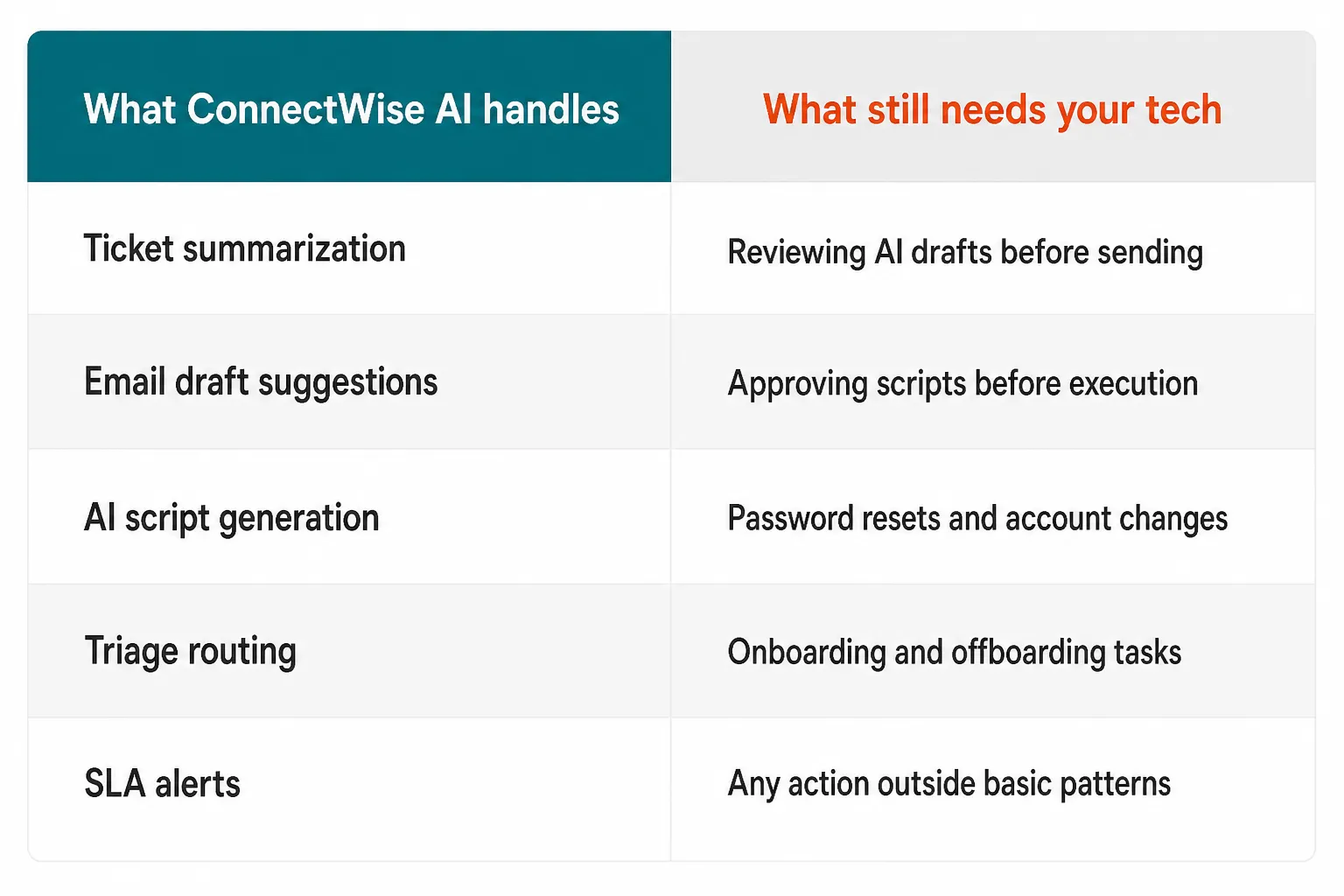
ConnectWise AI handles (or assists with):
- Ticket classification and routing on inbound volume
- Drafting email responses for technician review
- Summarizing long, multi-note tickets
- Generating scripts that a technician approves and executes
- Surfacing security posture data via natural-language query
- Flagging customer sentiment trends
Still requires a technician:
- Every customer-facing reply (review required before send)
- Every script execution (approval required before run)
- Anything outside basic, predictable patterns
- Password resets, account unlocks, onboarding, offboarding
- Complex triage that doesn't match historical patterns
- Custom reporting and cross-system data queries
The gap is significant. The tickets that burn the most technician hours - L1/L2 work like password resets, access provisioning, account management - aren't touched by ConnectWise AI's current implementation. These are execution tasks, not suggestion tasks, and ConnectWise AI is built for the latter.
The Honest Gap: Assist vs. Execute
ConnectWise describes their vision in terms of a "system of action" - the idea that AI should move from storing data (system of record) to taking action. It's the right framing. The problem is that most of Sidekick and the AI Agents are still firmly in "system of suggestion."
When an MSP is running 500 tickets a month and 40% of them are password resets, account unlocks, or permission requests, the ROI isn't in better triage suggestions. It's in those tickets never landing on a technician's queue in the first place.
That's the execution gap ConnectWise hasn't closed yet. Their roadmap points there. Their current product doesn't get you there.
For MSPs who need that execution layer now - autonomous L1/L2 resolution, no technician in the loop, same-week deployment - the tool built specifically for that is Rallied.
What Rallied Does Differently
Rallied is an AI technician, not an AI assistant. The distinction matters operationally.
Where ConnectWise Sidekick drafts a password reset response for a technician to review and send, Rallied resets the password. Where Sidekick suggests that an account unlock ticket should be routed to Tier 1, Rallied unlocks the account. Rallied's ConnectWise Manage integration picks up the ticket and posts the notes and time entry back into the PSA once the work is done.
The stack it connects to covers the full MSP environment: ConnectWise, Autotask, Halo PSA, SuperOps, Datto RMM, NinjaRMM, M365, Entra ID, Okta, JumpCloud, Google Workspace, IT Glue, and Hudu. It handles onboarding, offboarding, access management, password resets, account unlocks, and triage - end to end, without a human in the loop for L1/L2 work.
The deployment model is different too. No 6-month implementation, no dedicated admin overhead, no workflow-builder training period. MSPs go live in the same week.
The ROI anchor: $7,000-$15,000 per month in recovered technician time. Fifty to a hundred hours a month of L1 grunt work that stops landing on humans.
If your current AI story is "we use Sidekick for triage" and you're still watching techs spend half their day on grunt work, Rallied is worth a look.
Bottom Line
ConnectWise Sidekick and AI Agents are real products with real capabilities. Auto-triage, ticket summarization, script generation, sentiment analysis - these features work and they save time on the right kinds of tasks.
The ceiling is clear: everything requires human review. ConnectWise AI assists and suggests; it doesn't execute. For the high-volume, low-complexity work that eats MSP hours - password resets, unlocks, access requests - the platform's answer in 2026 is still "a technician will handle that, but faster."
If your biggest problem is technician throughput on L1/L2 work, the tool that fits that problem is execution-first, not assist-first. ConnectWise is building toward execution. They're just not there yet.
Rallied is an AI technician built for MSPs that autonomously resolves L1/L2 tickets - no technician in the loop, no 6-month implementation, no dedicated admin overhead. If you're evaluating AI for your service desk, see how it works.
To see how Rallied handles this inside your PSA, read about AI Ticket Triage and Routing for MSPs.
Frequently Asked Questions
What is ConnectWise Sidekick?
ConnectWise Sidekick is an AI assistant embedded in ConnectWise Manage (PSA), Automate (RMM), and Control. It suggests ticket categories, drafts email responses, generates scripts, and surfaces insights - but all outputs require human review before anything is sent or executed.
What are ConnectWise AI Agents?
ConnectWise AI Agents are four purpose-built agents - Service Desk, Triage, Data Analyst, and Oversight - that expand on Sidekick's capabilities. They're designed to handle classification, routing, data queries, and quality monitoring within the ConnectWise platform.
Does ConnectWise AI autonomously resolve tickets?
No. ConnectWise AI assists and suggests - it does not autonomously resolve tickets end-to-end. All AI-generated email responses require human review, and all scripts require technician approval before execution.
How much does ConnectWise Sidekick cost?
ConnectWise does not publish Sidekick pricing. It's sales-led, meaning pricing depends on region, deal size, and bundling decisions. Industry sources cite base Manage pricing at $45–85/month per concurrent technician, with Sidekick features likely bundled into higher tiers.
What's the difference between ConnectWise Sidekick and a tool like Rallied?
Sidekick assists humans - it drafts responses, suggests actions, and highlights patterns, but humans execute. Rallied executes autonomously - it resolves L1/L2 tickets end-to-end without a technician in the loop: password resets, account unlocks, onboarding, offboarding, access management.